The Great Separation: Fad Recruiting, Real Assets, and the Collapse of the Old Guard
For anyone tracking the fault lines of modern direct sales, the timing is nothing short of historic.
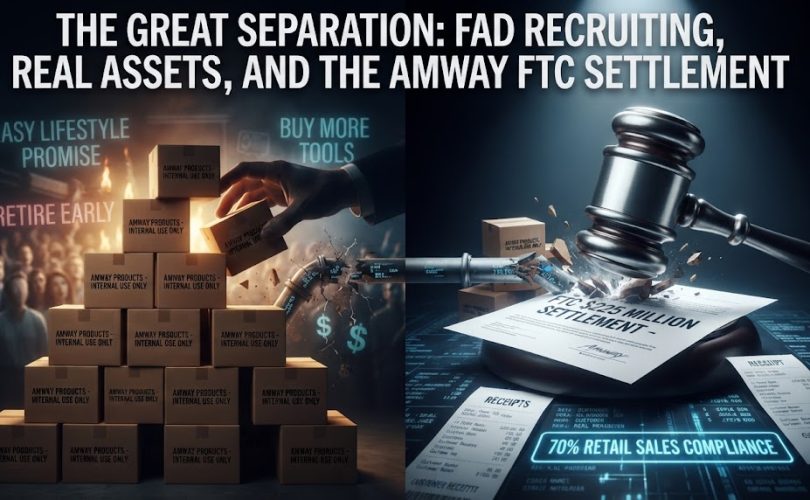
Just days after Part 3 of this series exposed how predatory outfits weaponize psychological pain points and manufacture false hope, the real world caught up with the rhetoric in monumental fashion. The Federal Trade Commission, alongside the state of Washington, dropped a massive $225 million settlement against Amway and its primary training affiliates, World Wide Group (WWG) and Leadership Team Development (LTD).
It stands as the largest monetary recovery in an FTC action against a multi-level marketing company. But more importantly, the federal complaint reads like a legal transcription of everything this series has diagnosed: the absolute fracture between fad recruiting and real asset building.
The Engine vs. The Broken Car
In Part 1 of this series, we established that tiered leveraged compensation is a neutral economic engine. The danger has never been the mathematical structure of leverage itself; the danger has always been the predatory operators who bolt that engine to a chassis built entirely on hype, inventory loading, and recruitment velocity, while ignoring the operational reality of actual product consumption.
The FTC’s case against Amway and its training groups exposed that exact broken vehicle.
Regulators laid bare how the machine operated behind the curtain:
-
The Promise vs. The Reality: Recruits were aggressively targeted with the classic lifestyle pitch—promises of early retirement, escaping traditional jobs, and making $40,000 or more a year.
-
The Cold Math: The actual federal data revealed a staggering median annual bonus of just $139 for Amway distributors before expenses. The vast majority of participants who joined after 2020 ended up spending more money on internal products and expensive mandatory training seminars ($2,100+ a year for basic membership, tools, and events) than they ever made back.
-
The Inventory Loading Trap: Instead of focusing on real-world retail customers who actually wanted the products on their own merits, affiliates were instructed to buy a set amount of inventory each month just to qualify for bonus points—stockpiling goods in closets and faking sales reports to make the recruitment engine look functional.
When the core product is just a ticket to ride the compensation wheel rather than something people would buy on utility alone, the entire business turns into a recruitment treadmill.
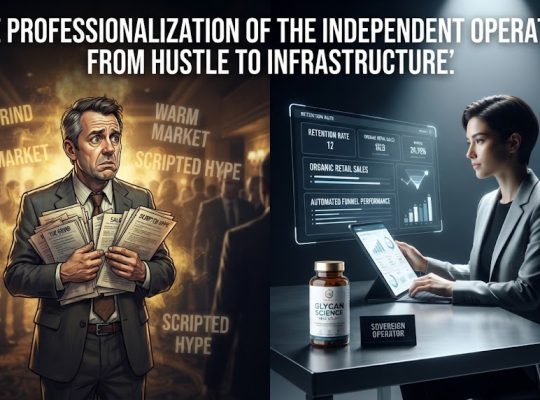
The Legal Cure Mirrors the Sovereign Operator Model
The most fascinating aspect of the September 2026 Amway settlement is what the court forced the company to do. Regulators didn’t outlaw the concept of direct distribution; they legally mandated the exact structural shift we have been arguing for: The Great Separation.
Under the new terms of the settlement, the old “hype-and-load” model is finished:
-
The Strict 70% Resale Rule: Amway is now legally forced to verify that at least 70% of the products purchased by distributors each month are actually resold to real, external retail customers. Internal consumption and inventory loading no longer count toward volume.
-
Disincentivizing Recruitment Without Retail: Recruiters will now receive substantially reduced compensation when their recruits buy products without backing them up with genuine external retail sales.
-
The Death of the Pay-to-Play Training Trap: Affiliates like WWG and LTD are barred from charging new recruits for training and motivational services during their first year, effectively cutting off the secondary scam of selling expensive “mindset” tapes to people who are already losing money.
The government essentially stepped in and codified the Sovereign Operator framework: If your business model relies on manipulating people into buying things they don’t need just to feed a recruitment chain, it’s illegal. If your business model relies on actual, verifiable product consumption and transparent systems, it survives.
The Choice for the Future
The old guard is dying. The illusion is broken, the fines have been levied, and the legal guardrails have been bolted down. You can no longer build a sustainable enterprise on smoke, mirrors, and emotional arm-twisting.
The future belongs to operators who treat distribution like a legitimate, clean, franchise-style business—where the products stand on their own, the customer data is transparent, and the systems respect the intelligence of the market.
The era of the hype-peddler is over. The era of the Sovereign Operator has arrived by law.
The Sovereign Operator’s Call
Stop building your future on the shifting sands of recruitment velocity and manufactured hype. Align yourself with a system built on real product utility, strict operational transparency, and true consumer demand.
Stay tuned for Part 5: “Engineering the Ethical Matrix—Designing Compensation That Rewards Truth,” where we examine how to build pay structures that only reward real consumer retention.
Copyright © 2026 MJ Enterprises
All rights reserved.