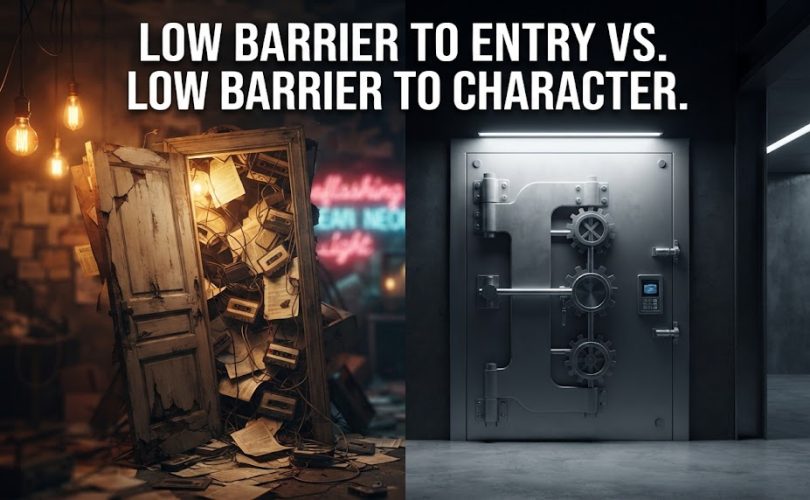
Low Barrier to Entry vs. Low Barrier to Character
In traditional business, entry is guarded by heavy gates. If you want to open a franchise, launch a logistics firm, or scale a regional manufacturing outfit, you have to clear massive hurdles: hundreds of thousands in startup capital, commercial lease negotiations, regulatory compliance, and rigorous financial underwriting.
Whether intended or not, those steep financial requirements serve a vital Darwinian function: they act as a character and competence filter. People who don’t take the venture seriously, or who intend to run a sloppy, short-term con, rarely risk their own life savings to do it.
Network marketing, by structural design, threw those gates wide open.
The Double-Edged Sword of Open Doors
The original democratic beauty of the direct sales model was its accessibility. Anyone with a modest registration fee could plug into a distribution network without needing a venture capitalist or a corporate boardroom behind them. It democratized entrepreneurship.
But a low barrier to entry instantly became a double-edged sword. When the front door has no lock, you invite everyone inside—not just earnest entrepreneurs looking for a vehicle, but opportunistic manipulators looking for easy prey.
Because the financial risk to enter was so low, it required zero skin in the game regarding professional standards. You didn’t need a resume, a background check, a business degree, or a moral compass. You just needed a credit card and a pulse.
How Hype-Peddlers Hijacked the Machine
This lack of a prerequisite filter allowed uneducated hype-peddlers to flood the industry and eventually hijack the entire economic model.
Without any operational discipline or understanding of long-term market retention, these opportunists treated the business like a high-speed carnival game. They didn’t care about supply chains, product utility, or customer reorder metrics. They cared about volume velocity, recruitment speed, and front-loaded sign-up bonuses.
They weaponized the low barrier to entry as a pitch in itself—“Anyone can do this in their spare time with zero experience!”—while completely ignoring the reality that without professional training, systemized discipline, and high-integrity character, “anyone” was almost guaranteed to crash and burn.
They took a legitimate mechanism of distribution and turned it into a magnet for short-term hustlers.
Rebuilding the Filter
If we want to rescue tiered leveraged compensation from the reputation it earned, we have to restore the filter.
Since we can’t use massive capital requirements to keep out the unqualified (nor should we, as accessibility is part of the vehicle’s core value), we must replace financial barriers with operational standards.
That means rejecting the hustle-culture hucksters. It means treating distribution not as a get-rich-quick lottery, but as a disciplined, turnkey franchise model where success is earned through systematic execution, transparency, and real product value—not through fast-talking manipulation.
When you raise the standard of the operator, you stop letting the low-character crowd drag the entire vehicle down.
The Sovereign Operator’s Call
You have read the diagnosis. Now, it is time for the cure. Stop building your future on the shifting sands of hype, recruitment, and empty promises. Join a system built on the bedrock of real business fundamentals, logistical efficiency, and genuine product utility.
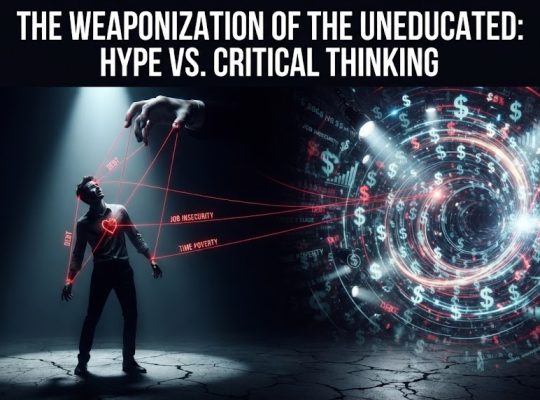
Stay tuned for Part 3: “The Weaponization of the Uneducated,” where we examine the psychological tricks used to sell the dream of overnight wealth.
Copyright © 2026 MJ Enterprises
All rights reserved.